
Haze between the panes means the seal failed, and no cleaning will touch it.
Foggy Window Repair
Foggy Window Repair
Foggy window repair in Phoenix
Family owned and operated since 2010
Insulated units fabricated here in Phoenix, back in five to seven days
The frame stays in the wall, so no stucco or drywall work follows
Free written quote after a technician measures on site
A Lifetime Limited Warranty backs our workmanship
A 50% deposit once you approve, because the glass is cut to your opening
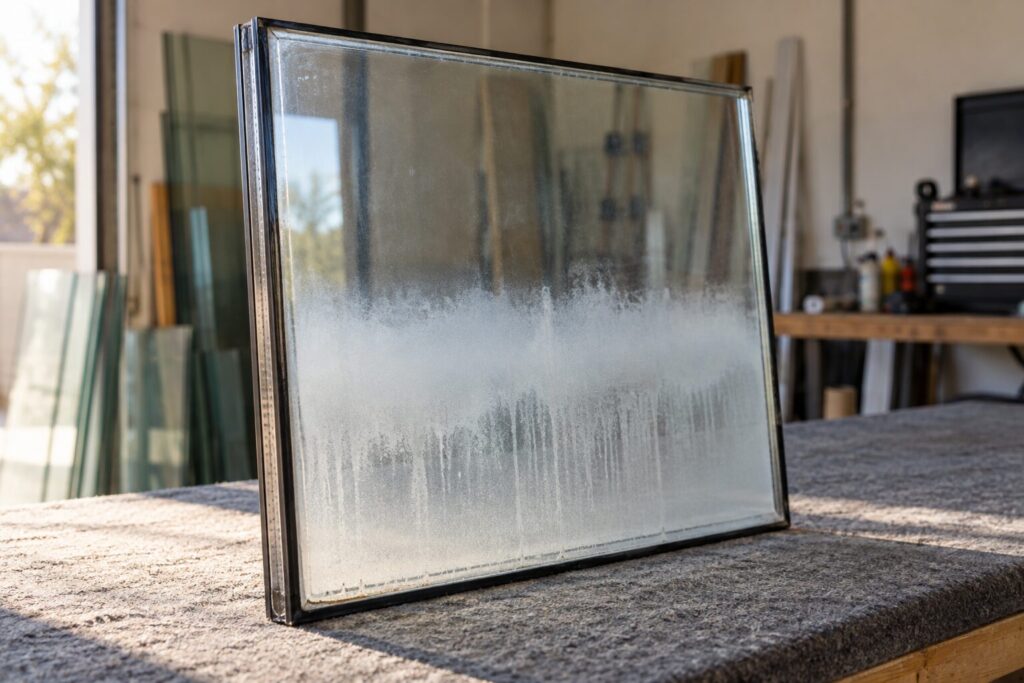
Haze trapped between the two panes of a window means the seal around that glass unit has failed, and no amount of cleaning will touch it because the moisture is on surfaces you cannot reach. The repair is a new insulated glass unit fitted into the frame you already own. The wall, the frame and the finish stay exactly as they are, and custom units come back from Phoenix fabricators in five to seven days.
What the cloudiness between the panes is telling you
An insulated glass unit is two panes of glass held a fixed distance apart with a sealed cavity between them. That cavity is meant to stay dry forever. Once the seal lets go, humid outside air works its way in, and the water vapor it carries has nowhere to leave.
Then physics does the rest, night after night. As the glass cools after dark, the air in the cavity drops below its dew point and the vapor condenses onto the inner faces of both panes. Morning sun warms it, some of it evaporates, and by afternoon the window can look almost normal. Over months the cycle leaves mineral residue etched into the glass, which is the permanent gray film people describe as a stain that will not come off. It will not come off, and that is the point at which the unit is beyond saving even in theory.
How is an insulated unit sealed?
Understanding the construction explains why the repair is what it is. Around the perimeter of the unit sits a spacer bar filled with desiccant, which absorbs the small amount of moisture present when the unit is assembled. Two separate sealants hold the assembly together:
- a primary seal of polyisobutylene, a soft black compound pressed between the spacer and each pane, which is the actual barrier keeping water vapor out
- a secondary seal of silicone or polyurethane around the outer edge, which carries the structural load and bonds the two panes to the spacer as one rigid unit
Neither sealant can be reached or renewed once the unit is glazed into a sash. They are applied on a production line, under pressure, to clean glass, and nothing sprayed, injected or wiped from outside restores them.
Why do dual pane seals fail early in Phoenix?
Because of movement, and this valley produces more of it than almost anywhere. A west-facing unit here climbs through a wide temperature swing every single day for roughly eight months of the year, hot glass in the afternoon and cool glass by dawn. Glass, aluminum or vinyl frame, spacer and sealant all expand and contract with each swing, and they do it at different rates.
The sealant absorbs that difference. It stretches and relaxes thousands of times a year, and elastic materials fatigue when you work them that hard. A unit that would run twenty years or more in a mild coastal climate can fail here considerably sooner, which is why fogging shows up on the west and south elevations first and can leave the north side of the same house untouched.
Two other local factors add to it. Direct ultraviolet exposure degrades the outer sealant on units without a protective glazing bead, and roof heat radiating down onto upper story windows through summer afternoons keeps them at temperature longer each day than the ones below.
Can a foggy window be cleaned?
No. This is the question we hear most and the answer does not have qualifiers. The condensation and the mineral etching are on the two interior faces of the sealed cavity, and those faces have been inaccessible since the day the unit left the production line. Cleaning the room-side and the outside surfaces removes fingerprints and hard water spots. It changes nothing about the haze, because you are working on the wrong side of the glass.
Do the defogging services that drill the glass work?
Not in any way that lasts, and we would rather tell you that before you spend money. The method involves drilling a small hole through one pane, flushing or vacuuming the cavity, sometimes fitting a breather vent, and letting the moisture leave.
The visible haze usually does clear for a while. The problem is that the seal is still broken, and now there is a deliberate hole in the unit as well. Outside air continues moving in and out, carrying moisture and dust with it. The desiccant is spent and cannot be recharged. Any etching already burned into the glass stays where it is, because no wash reaches it. The insulating value never comes back, since the cavity is now vented to the outdoors rather than sealed. Homeowners who go this route generally see the fog return within a season or two, and then they replace the unit anyway.
What gets replaced, and what stays in the wall?
The insulated glass unit is replaced. The frame stays in the wall. That distinction is the good news in this whole subject, because it means no stucco is cut, no interior finish is disturbed, and nothing needs painting afterward. Frame work, drywall repair, stucco patching and painting are outside what we do, and a seal failure does not call for any of them.
A technician removes the glazing bead or the stops, lifts the failed unit out of the sash, cleans the glazing channel, sets the new unit on fresh setting blocks so the weight is carried where it should be, and returns the stops. On some window styles the sash comes out to the truck and goes back in when the new unit is seated. Where the sash also has dead springs and will not hold position, that gets sorted at the same visit, and window balance replacement explains what that side of the work involves.
How long does the new unit take?
Five to seven days for a custom size. Insulated units are made to the exact dimensions of your opening by fabricators here in Phoenix, so a measure this week is generally a fit next week. We do not build them in house and we do not pretend to; the local shops do that work well and they do it to the tolerances the frame needs.
What the fabricator needs from us is precise, which is why a technician measures on site rather than trusting numbers over the phone. Glass cut to your opening cannot be sold to anyone else, so a 50% deposit falls due once you approve the quote and before the order is placed. Nothing is owed before you have that quote in writing.
What the technician records at the measure
More than the width and height, because two units of the same size are not necessarily the same unit:
- overall dimensions of the glass, taken from the sash rather than the frame
- overall thickness of the unit, which is set by the spacer and the two glass thicknesses together
- whether the glass has to be tempered, which depends on the location of the window in the house
- whether the original had a low emissivity coating, and on which surface it sat
- glass tint, since bronze and gray units are common on older valley homes and a clear replacement will stand out
- the condition of the sash, the glazing channel and the stops holding it all in
Tempering matters for a reason worth knowing. Tempered glass cannot be cut, drilled or notched after it has been heat treated, so it has to be ordered at final size and no adjustment is possible on site. Laminated glass satisfies the same safety glazing requirement and can be cut at the house, which is how some jobs finish the day they start. For single glazed openings, the same measuring logic applies and the turnaround is quicker, as set out under single pane glass replacement.
Are weatherstripping and perimeter seals the same problem?
No, and mixing the two up leads people to the wrong repair. The seal inside an insulated unit is a factory sealant you cannot renew. Weatherstripping, glazing gaskets and the perimeter seals around a sash are separate parts, they are meant to be replaced, and we replace them.
They fail differently here as well. In a wet climate they wear out from friction and water. In Phoenix they die of ultraviolet exposure and heat, going hard and chalky until the fins no longer press against the frame. The complaint that follows is rarely a draft. It is dust: a fine layer on the sill each week, worse after a wind event, from a window that seals nowhere near as well as it looks like it does. That is an inexpensive fix compared with glass, and it often gets done on the same visit.
Does one failed unit mean all the windows have to go?
It does not. Seals fail one unit at a time, usually starting with the elevations that take the most sun, and replacing the failed ones while leaving the sound ones alone is the sensible course in most houses. We will happily quote three windows and leave the other eleven.
The calculation shifts when a majority of the units in a house have gone at once, when the frames themselves are failing, or when a homeowner wants a performance level that the existing frames cannot carry. At that point whole window replacement is the honest recommendation, and we will say so rather than selling glass into frames that are finished. For anything short of it, dual pane glass replacement keeps your existing windows and costs a good deal less.
What moves the price of a foggy window job?
Size drives it hardest, since glass is priced by area and a large picture window carries several times the material of a bathroom unit. After that: whether the unit must be tempered, whether it needs a low emissivity coating or a tint match, how the sash is glazed and how much work it takes to open up, and how many units you are doing at once. Access counts too, because a second-story window over a slope is a different setup from a ground-floor slider.
We do not publish figures for residential glass, and any number quoted to you sight unseen is a guess. A technician measures, you get it in writing, and you decide from there.
Questions homeowners ask about foggy glass
Who makes the replacement insulated units?
Local glass fabricators here in Phoenix build them to our measurements, and they come back to us in five to seven days. We have worked with valley fabricators since 2010, which is how a custom size on an odd opening still lands inside that week.
Where does fogging usually appear first in a Phoenix house?
On the west and south elevations, and on upper floors before lower ones. Those are the units taking the longest heat exposure and the widest daily swing. If you are checking your own house, walk it in the early morning when the condensation is still sitting on the glass, since the same window can look clear by two in the afternoon.
Can you replace just one pane of the two?
No. The two panes, the spacer and both sealants are manufactured as one sealed assembly, and separating them would destroy the seal that makes it work. The whole unit is replaced as a piece and the sash it sits in stays.
Is a fogged window still doing anything for my energy bill?
Some of it, but not what it was built to do. A cavity open to outside air has lost the still, dry gap that gives a dual pane window its insulating value, and any coating on the cavity surfaces is being degraded by the moisture sitting on it. You keep the two layers of glass. You lose most of the reason for having two.
Will a failed seal turn into a broken window?
Rarely. A seal failure is a performance and appearance problem rather than a structural one, and units sit fogged for years without cracking. What does happen is that the etching becomes permanent and the view degrades from a light haze to something you cannot see through, so there is no advantage in waiting once you have decided to fix it.
Does my window warranty cover this?
Manufacturer warranties on insulated units are common and worth checking before you call anyone, since some run ten or twenty years on the seal. Look for a stamp or spacer marking on the unit itself. If the coverage has run out or the maker is no longer trading, which happens often with valley homes built in the 1990s, replacement glass is the route. Our own lifetime limited warranty covers our workmanship for as long as you own the property.
Can you do a foggy sliding patio door panel?
Yes, and those are usually tempered, so the panel is measured and the unit ordered at size rather than cut at the house. If the door is also dragging or noisy while you are getting the glass sorted, the wheels are worth checking, and sliding door roller and track repair covers that side of it.
There is water on the inside face of my window. Same thing?
Different thing. Condensation you can wipe off with a cloth is room humidity meeting cold glass, which shows up on winter mornings in kitchens and bathrooms and points at ventilation rather than a failed unit. Fog you cannot wipe off, on either face, is inside the cavity and is a seal failure.
Book a measure for foggy glass
Call (602) 777-3717 between 7:30am and 5:00pm, Monday to Friday, and tell us how many windows are hazed and which side of the house they face. We work within a 50 mile radius of 4202 E Elwood St #21, Phoenix, AZ 85040, a dispatch and parts location where no glass is sold to the public, so the measure and the fit both happen at your home. See the rest of what we handle at our residential window services, or read up on home window repair if more than the glass is giving you trouble.
Which cities do we cover?
We work across the Valley, inside 50 miles of the shop on Elwood Street. Start with your city for what we see most in the housing stock there.
Fogging is a glass failure, not a frame failure, so it rarely leads to window installation. We will say so if it does.