
Broken, cracked and fogged storefront and commercial entry door glass, measured and quoted on site.
Storefront Glass
Storefront Glass
Storefront glass and entry door glass in Phoenix
Family owned and operated since 2010
Free site measure and written quote
Tempered cannot be cut after heat treatment, so every detail is specified before fabrication
Laminated can be cut on site, which is often how a door goes back in service the same day
A Lifetime Limited Warranty backs our workmanship
After-hours calls are picked up and we get the opening secured
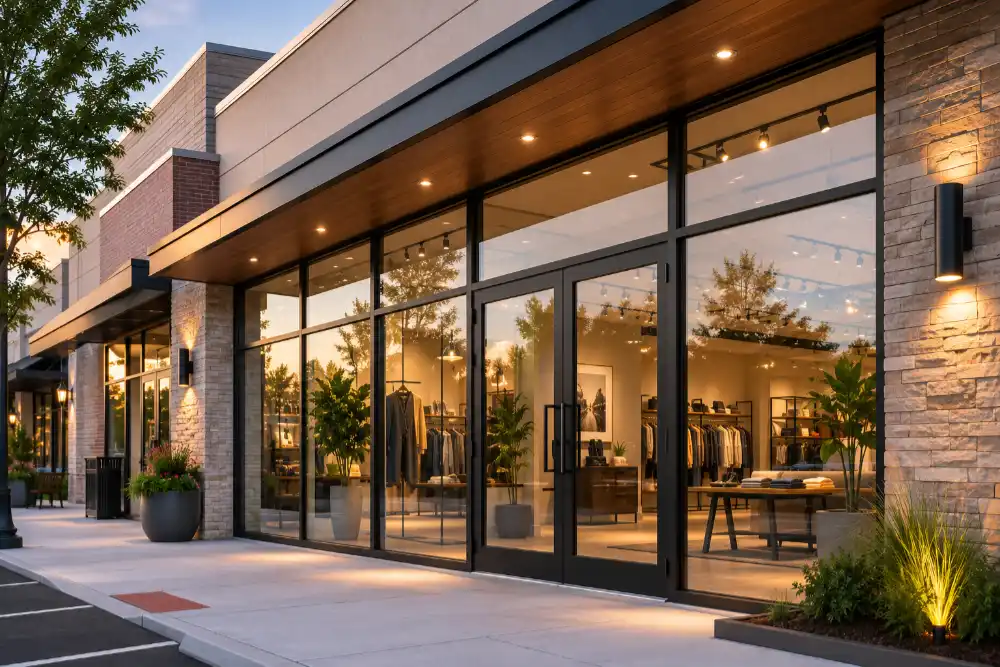
We replace broken, cracked and fogged storefront glass and the glass in commercial entry doors, anywhere inside a 50 mile radius of Phoenix. A technician measures the opening on site, you get a written quote, and the lite is fabricated to that measurement, because storefront glass is cut to the building rather than pulled off a shelf.
Superior Replacement Windows has worked on commercial glass since 2010. If the front of your building is open right now, call us first and read afterward. Securing the opening comes before everything else.
What does a broken storefront mean for the business before it is fixed?
It means the building is open. Not just to weather and dust, though a summer storm through an empty aluminum frame does real damage to a floor and to stock, but to anybody who wants in after closing. An unglazed opening is a door with no lock to pick.
That is why the sequence is almost always secure the opening first, glaze it second. Trying to do both in one visit sounds efficient and is the reason businesses sit exposed overnight, since the permanent lite does not exist yet. It has to be made. The board goes on the same visit; the glass arrives when the fabricator has built it.
If your front is currently open, the first call is about closing it. Emergency board-up covers that visit, including what to photograph before anybody clears the debris. The permanent glass follows once the opening is secure.
What is a storefront system made of?
Storefront is extruded aluminum framing, assembled on site into a grid of verticals and horizontals, with glass captured in a channel called the glazing pocket. Gaskets or wet sealant hold the lite in that pocket. There is no sash and nothing operable except the doors.
Two things go in those pockets on the buildings we work on:
- Quarter inch tempered glass. The default for monolithic storefront and for the fixed lites around an entrance. One piece of glass, heat treated, sitting in the pocket against gasket on both faces.
- One inch insulated units. Two lites separated by a spacer with a sealed air or gas space between them. These need a deeper pocket, and if the frame was built for monolithic glass, a one inch unit will not go into it.
Frameless entries are their own animal. A frameless door is usually half inch tempered glass with metal patch fittings clamped at the corners carrying the pivots, the lock and the closer, and the holes for all of that are cut into the glass before it is heat treated.
Why is storefront glass nearly always required to be safety glazing?
Because of where it sits. Building code names hazardous locations, and storefront glass hits several of them at once. It is glass in a door. It is glass next to a door. It is large glazing at ground level with a walking surface on both sides of it. Glass in wet areas and glass in guards are hazardous locations too, but on a storefront it is the door and the ground level position that decide the answer before anyone measures anything.
Safety glazing on a storefront means tempered in most cases, laminated where the building wants the panel to stay in the frame after it breaks. Either way the lite carries a permanent manufacturer’s mark, etched or sandblasted or ceramic fired into the glass so it cannot be peeled off. A sticker is not a mark. An unmarked lite in a hazardous location is a failed inspection.
Our tempered and safety glass page covers which openings qualify and how tempered and laminated differ. What matters on a storefront quote is simpler: assume the glass has to be safety glazing and be pleasantly surprised on the rare fixed panel that does not.
Are you replacing a lite, or replacing the frame?
This is the fork that decides the size of the job, and it is the first thing a technician settles on site.
Replacing a lite in an existing frame is a glass job. We de-glaze the opening, pull the old gasket or cut out the old sealant, drop the new lite in, and re-glaze it. The framing stays where it is. Most broken storefront panels are exactly this.
Replacing framing is a different scope with a different budget, and there are three situations that force it. A vehicle strike that has bent or torn the aluminum. Corrosion or damage at a sill that will not hold a seal any more. And the one nobody expects: a request to put insulated glass into a frame that was never deep enough for it. Shallow non-thermal storefront systems accept up to about three eighths of an inch. A one inch unit does not fit, and no amount of gasket work makes it fit.
So when somebody asks whether we can upgrade their single pane storefront to dual pane, the honest first answer is that we have to identify the framing system first. If the pocket takes it, it is a glass job. If it does not, you are buying framing, and we will say so at the measure rather than after a deposit. The way scopes get split between those two paths is covered under commercial glass.
Why is the door hardware a separate question from the glass?
Because most of what goes wrong with a commercial entry door has nothing to do with the pane in it. The glass is inert. The hardware is the part doing work every time somebody comes through, several hundred times a day on a busy front.
- Floor closers. The closer sits in a cement case under the threshold and absorbs every swing the building sees. A door that slams, or that stops returning to square, is usually the closer.
- Pivots and hinges. Wear shows up as a door that drops, drags on the threshold, or stands proud at the top rail.
- Patch fittings and rails. Gaskets inside the fitting compress over the years and the glass starts to move within the clamp. A loose patch cracks glass eventually.
- Locks, pulls and panic hardware. Separate goods, separate failure modes, and often the reason a door is propped open rather than latched.
- Thresholds and sweeps. The unglamorous parts that decide whether the front seals.
The reason it is not fully separate is that the hardware is machined into the glass. Holes for a lock, cutouts for patch fittings, notches for a rail: every one of them is cut while the glass is still annealed, before it goes through the tempering furnace. Change the hardware to something with a different hole pattern and you are ordering new glass whether you wanted to or not. Changing hardware can also affect how the entrance performs against accessibility requirements, and your building official has the final say on that.
Send a short video of the door swinging and closing. We can usually tell from that whether you have a glass problem or a closer problem, before anybody drives out.
How is a storefront lite measured, and why does that set the lead time?
We measure the glazing pocket, daylight opening and frame depth, not the broken piece. Old glass has often shifted, and on a damaged front the frame itself may be out of square, so measuring the debris gives you a lite that does not fit.
Then the lite gets fabricated to those numbers, and here is the part that governs the calendar. Tempered glass cannot be cut, drilled or notched once it has been heat treated. The tempering process puts the surfaces into compression against a core in tension, and cutting into that releases the whole panel at once. Every dimension, hole, notch and edge detail has to be right before the glass goes in the furnace. There is no trimming an eighth of an inch off on site, and a mis-measurement is a re-order rather than an adjustment.
Laminated glass behaves differently and can be cut on site, which is one of several reasons a specification sometimes calls for it. Insulated units are built by fabricators here in Phoenix and come back in five to seven days. Monolithic tempered moves faster than that. The date lands on your written quote so the store, the office or the restaurant can plan around it.
Why does a broken tempered lite empty the entire opening?
Tempered glass is heated and then quenched fast, which locks the surfaces into compression and leaves the core in tension. That is what makes it around four times stronger than ordinary annealed glass of the same thickness. When it does finally fail, the stored energy releases everywhere at once and the panel dices into small blunt pieces. There is no partial break to tape over and no cracked-but-standing pane to live with for a week.
Two causes account for most storefront breakage that nobody caused on purpose. Edge damage is the first and the most common: a nick picked up during handling or an earlier installation sits in the edge, which is exactly where the frame holds the panel and where the load concentrates, and months later it opens into a crack. Thermal stress is the second, and Phoenix produces it readily on a panel that spends the afternoon half in shade and half in full sun, since the hot center expands against a cooler edge held in the frame.
Fully tempered glass also carries a small inherent risk of spontaneous breakage from a nickel sulfide inclusion, a microscopic particle that can expand years after installation and take the panel with it. It is a characteristic of the material, not a workmanship fault, and on projects where that risk matters the usual answer is to specify heat-soaked glass. Guards and railings are where this comes up most, and it is covered under glass railings and guards.
What do we need in order to quote your storefront?
Five things, and you can gather all of them from your phone in about two minutes.
- A photo of the whole opening, taken far enough back that the frame around the glass is visible. A close-up of the crack tells us nothing about the pocket.
- Rough width and height. Tape measure accuracy is fine. A technician takes the real numbers.
- Whether the glass is single or insulated. If any edge is visible, look for a metal spacer between two panes.
- Whether anything passes through the glass. A lock cylinder, a pull, a closer arm, a rail. That turns it into a hardware conversation as well as a glass one.
- The property address. It tells us which jurisdiction inspects the work and what access the site has.
None of this replaces the site measure. It lets us say on the phone whether you have a lite, a frame, or a door that needs a closer.
Which details move the price of a storefront job?
We do not publish storefront prices, because two openings of the same size can be entirely different jobs. What moves the number:
- Whether the lite is monolithic, insulated or laminated.
- Thickness, and whether tempering or laminating is required by the opening’s location.
- The size of the panel, since large lites cross the point where handling needs more crew or suction equipment.
- Access. A curb-side bay is straightforward. A front behind a service drive, or above a canopy, is not.
- Hardware, if a closer, pivot set or rail is part of the fix.
- Tint, coating and whether the panel has to match neighboring glass on a visible elevation.
On approval of the written quote we collect 50% before the glass is ordered. Your lite is cut to your opening and cannot be resold to anyone, which is the whole reason the deposit exists. Hardware and stock sizes are the exceptions. Nothing is owed until the written quote is in your hands.
Questions we get about storefront glass
Who should call us on a leased suite, the tenant or the landlord?
Whoever can approve the quote and the deposit, which the lease usually decides. In practice a tenant or store manager calls first because they are standing in front of the damage, and we quote to whoever the property manager or owner tells us to bill. We will send the same written quote to both parties so nobody waits on a forwarded email.
Where do you replace storefront glass, and is there somewhere to come and see glass?
Anywhere inside 50 miles of Phoenix, which covers the metro. We are based at 4202 E Elwood St #21, Phoenix, AZ 85040, a trade address with no display floor and no public counter. The glass you are choosing between gets discussed at your building, in front of the opening it is going into.
Can you re-glaze the opening without taking the frame apart?
On most storefront systems, yes. The glazing stops or the gasket come out, the lite goes in, and the frame stays assembled and anchored. Frames only come apart when the framing itself is damaged or when the pocket has to change to hold different glass.
My entry door drags and will not latch. Is that a glass problem?
Almost never. Dragging, slamming and failure to latch point at the floor closer or the pivots. Glass does not change shape. Get us a video of the swing and we will tell you which part is tired.
Does a fixed panel beside the door have to be tempered?
If its bottom edge is under 60 inches and it sits within a 24 inch arc of the door, yes, and on a normal storefront entrance that describes the sidelight exactly. Panels further out may still qualify on size and proximity to the floor. We identify every hazardous location on your elevation at the measure so nothing gets ordered as the wrong product.
Can we switch a single pane storefront to insulated glass?
Only if the framing was built to take it. Deep systems will hold a one inch unit. Shallow non-thermal systems top out around three eighths of an inch and cannot, so getting insulated glass into them means new framing. That is a bigger scope, and it is worth pricing against what the energy saving is likely to be over the lease term.
What if the front breaks after you have closed for the day?
The office runs 7:30am to 5:00pm, Monday to Friday, and calls that land outside those hours on a commercial emergency are picked up. What happens on that call is that we work on getting the building secured. The permanent glass follows once it has been made.
What does the warranty cover on storefront work?
Installation work is covered by a lifetime limited warranty that runs while the building is yours. It applies to how the lite is set, glazed and sealed. Glass and hardware keep the manufacturer’s own coverage. A panel broken later by impact is a new job, and if one opening keeps failing we will tell you why rather than sell you the same glass twice.
Does replacing storefront glass affect ADA compliance?
The glass itself, no. The hardware around it, sometimes, and that is the part worth flagging before anyone orders parts.
An accessible entrance has to meet a set of dimensional and operational requirements, and several of them live in the door rather than the glass. If a broken entry door gets rebuilt with a different closer, a different pull, or a thicker threshold, an entrance that complied on Monday can stop complying on Friday. Nobody sets out to do that. It happens because the glass and the hardware get treated as one job when they are two.
The requirements that most often come up on a storefront entry:
- Clear opening width of 32 inches minimum. Measured with the door open at 90 degrees, from the face of the door to the stop on the frame, not from the frame opening. A door that measures 36 inches on the plan can deliver less than 32 once the leaf and the stop are accounted for.
- Hardware operable with one hand, without tight grasping, pinching or twisting of the wrist, mounted between 34 and 48 inches from the floor. Lever handles and panic hardware pass. Round knobs and thumb-turn latches are the usual failures.
- Thresholds no higher than half an inch on new work, with anything above a quarter inch beveled. Existing thresholds are allowed slightly more.
- A closer sweep of at least five seconds from 90 degrees to 12 degrees, so the door does not shut faster than someone can pass through it.
- A smooth push-side surface across the bottom ten inches of the door, which is why a kick plate is specified rather than assumed.
Opening force is also limited, and this is the one we will not put a number on. The federal standard, the building code and some state amendments do not all say the same thing, and the limit depends on the door type and on where the building sits. Anyone quoting you a single figure for an exterior storefront door is oversimplifying. The building official is who rules on it.
What this means practically: we are a glass company, not an accessibility consultant. What we do is tell you when a repair is about to change something that affects the entrance, so the decision is yours and it happens before the parts arrive rather than after an inspection. If the entrance is on an accessible route and the hardware is changing, that is a conversation to have at the measure.
Get the opening measured
Call (602) 777-3717 Monday to Friday, 7:30am to 5:00pm with the address and a photo of the opening, and we will schedule a technician to measure and quote it. If the front is broken and standing open, say that on the call. For what happens before the glass arrives, see emergency board-up, and for how interior glass is handled on the same building, see office partitions and interior glass.
Which cities do we cover?
We measure and glaze commercial property across the metro, inside a 50 mile radius of the shop on Elwood Street.