
One question decides almost everything about a glass guard: is there a walking surface underneath it?
Glass Railings
Glass Railings
Glass railings and guards in Phoenix
Family owned and operated since 2010
Safety glazing specified to the code edition your building is held to
Free site measure and written quote
Tempered cannot be cut after heat treatment, so every detail is specified before fabrication
A Lifetime Limited Warranty backs our workmanship
A 50% deposit once you approve, because the glass is cut to your opening
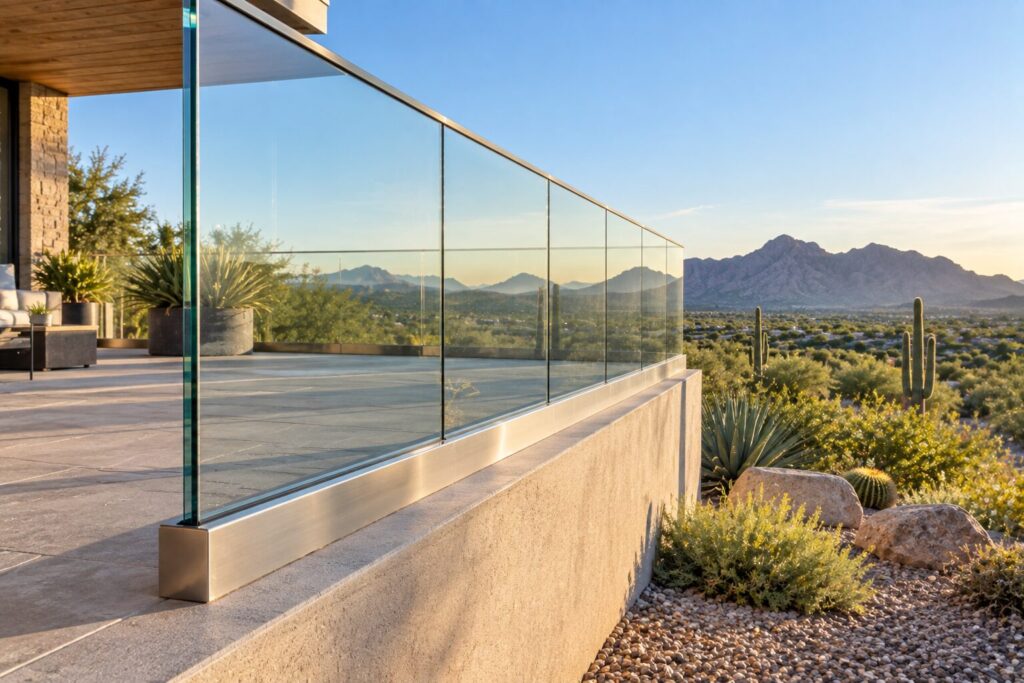
One question decides almost everything about a glass guard: is there a walking surface underneath it? Where there is, the code calls for laminated glass built from fully tempered or heat-strengthened plies. Where there is not, or where the surface below is permanently protected from falling glass, monolithic fully tempered is permitted provided it meets the higher impact category.
That pair of answers gets flattened into “guards must be laminated” all the time, and the flattened version is wrong. We have been glazing guards, balcony rails and stair infill around the valley since 2010, and the first thing a technician does on site is look down.
What decides the glass in your guard?
Every piece of glass in a guard is a hazardous location under the code, whatever its size and whatever height it sits at. That much has no exceptions. What the code does not do is demand identical glass in every guard.
- Nothing below, or the surface below is permanently protected. Monolithic fully tempered glass is permitted, so long as it meets the higher impact category. A patio guard at grade, a pool surround, a planter edge and a guard over landscaping usually land here.
- A walking surface below. Laminated glass, made up from fully tempered or heat-strengthened plies. Balconies over a sidewalk, mezzanine edges above a shop floor, stair and landing guards over occupied space.
State the requirement without its exception and you have given somebody a wrong answer, not a simplified one. Plenty of guards in the metro sit over dirt, gravel or planting, and specifying laminated for those adds weight, cost and lead time the code never asked for.
Why does the code draw the line there?
Because lamination in a guard has one job: holding the pieces together so they do not land on a person below. The interlayer keeps a broken panel roughly where it was until somebody can get to it, and that only counts for something where a person can be underneath.
A permanently protected surface, meaning a canopy or a structure that stops glass reaching anyone, satisfies the same purpose by other means. Which is why two guards that look identical from the street can carry different glass, and why the difference is in the slab below rather than anything visible in the railing.
What is a baluster, and why does the code want at least three?
A glass baluster is a panel doing structural work: it holds the guard up rather than filling a hole in a frame someone else built. Non-structural infill sits in a metal frame that would stand on its own if the glass vanished. The distinction changes what happens when a panel fails.
Each guard section needs at least three glass balusters, or support that keeps the guard standing if a single baluster fails. Lose one panel out of a run of six and there is still a guard there. Lose one out of a run of two and you have opened a gap someone can fall through, which is precisely the outcome the rule exists to prevent.
On a repair that turns into a question you may not expect: how many panels are in the section, and is anything but the glass holding the run up? A two-panel run beside a stair is a different conversation from a long balcony line.
Do you need a top rail on a frameless glass guard?
A top rail is required. There is one exception, and it has two halves that both have to be satisfied.
The rail may be omitted where the balusters are laminated glass with two or more plies of equal thickness and the same glass type, and the building official approves. Read the second half carefully. The approval is part of the exception rather than a formality, so a top-rail-free design is not something a glazier decides on your behalf. Raise it with the plans examiner while the drawings are still drawings, since a laminated make-up cannot be adjusted after fabrication.
Where the approval is not forthcoming, a slim stainless or aluminum cap rail is the usual answer, and it also protects the top edge of the glass from the knocks that cause failures later.
How much load does a glass guard have to carry?
50 pounds per linear foot, applied in any direction at the top. In any direction is the part people skim past: outward, inward and downward all count, so a guard designed only to resist a shove from inside the balcony has not met it.
That load drives glass thickness, base shoe depth, fixing spacing and what the slab edge has to be capable of. It is also why a guard panel is not glass you order by dimension alone. Thickness, ply make-up and fixing method work as a system, and changing one without checking the other two is how a guard ends up compliant on paper and soft in practice.
Can you glaze a parking garage handrail?
No, with a narrow exception. Glazing is not permitted in parking garage handrails except in pedestrian areas. Stair towers, elevator lobbies and marked pedestrian routes can be glazed. The vehicle levels cannot, because a car striking a glass guard is a different event from a person leaning on one.
A property manager inheriting a structure with glass somewhere it should not be has a real problem, and the fix is usually a metal guard rather than heavier glass.
How are guard panels usually held?
The fixing method changes the price, the lead time and whether a single panel can come out on its own, so we identify it early on site.
- Base shoe. A continuous aluminum channel bolted or cast into the slab, the panel set in it on a dry gasket or wet-set grout. Pulling one panel usually means loosening the gaskets either side.
- Point fittings, standoffs and spigots. Stainless fixings through drilled holes or clamping the edge. Every hole was drilled before tempering and cannot be moved afterward.
- Framed channel. Glass captured on two or more sides in a metal frame, most often as infill rather than as a structural baluster. The most forgiving to replace.
- Top-rail supported systems, where a cap rail ties the heads of the panels together and shares the load along the run.
Point-fixed panels catch people out on a repair. Hole positions, diameters and countersink all have to match the existing fittings exactly, which means measuring the fittings rather than the panel.
Is replacing one broken panel a like-for-like job?
Not automatically, and this is the part that surprises building owners.
Plenty of guard glass installed before the code tightened is monolithic tempered, including in positions with a walking surface below. If one of those breaks and there is occupied space underneath, putting the same glass back may not satisfy an inspector today even though it passed when it went in. The replacement can end up thicker and heavier, which then asks questions of a base shoe and fixings sized for the old panel.
Whether it bites on your job depends on whether the work is permitted and which jurisdiction the property sits in. We tell you which situation you are in at the measure, before anything is ordered.
Which code edition covers your property?
Arizona leaves adoption to each jurisdiction, so the edition in force depends on where the building sits rather than on the calendar.
The City of Phoenix has been on the 2024 building code since 1 August 2025. Unincorporated Maricopa County is still on the 2018 code. Two properties a short drive apart get held to different editions, and a portfolio spread across city and county lines can be subject to both at once. The building official has the final say in either case, and on anything permitted we would rather have a position confirmed by the plans examiner than assumed by us.
Why did the guard glass break when nothing hit it?
Three causes account for nearly all of it, and they point at different fixes.
Nickel sulfide inclusion. Fully tempered glass carries a small inherent risk of spontaneous breakage years after installation, when a microscopic inclusion trapped during manufacture expands inside the pane. It is rare, it is real, and it is not a workmanship fault. Where a project cannot carry that risk, heat-soaked tempered glass is the response, since the soak provokes unstable panels into failing at the factory instead of on your building.
Edge damage. A guard panel is gripped along its base and sometimes at points, so its edges carry the load and the edges are where a nick from handling or installation turns into a crack. This is the most common cause we find, and it is why we inspect the edges of the neighboring panels while we are on site rather than only measuring the broken one.
Thermal stress. Less frequent in a guard than in a window, but genuine in Phoenix where half a panel bakes in the afternoon sun while the other half sits in shadow from a wall or a stair stringer. The expansion difference pulls on the cooler edge until a flaw there opens.
The break pattern usually tells us which one it was, since dice across the whole panel, a break running from a single edge point and a crack perpendicular to the edge all read differently. More on how each glass type behaves is on our tempered and safety glazing page.
Where do glass guards turn up on commercial property?
More places than the phrase suggests. Balcony fronts on multifamily and hospitality buildings, mezzanine edges in showrooms and warehouses, open stair and landing guards in offices, roof terraces, pool and courtyard surrounds, elevated walkway edges, and low guards at a change in floor level inside a lobby. Interior guards get missed on condition surveys most often, because they read as furniture rather than structure, and they sit beside the same glazed walls covered on our office partitions and interior glazing page.
What we need to quote your railing
Send photos and answers to these and we can tell you a lot before anyone drives out.
- A photo of the whole railing run, taken far enough back to show how many panels are in the section and what the ends do.
- A photo of the broken panel in its fitting, close enough that we can see the base shoe, the standoff or the channel and how the glass is held.
- Whether there is a walking surface below the guard, and whether anything permanently protects it.
- Rough panel dimensions, height and width, measured or paced.
- How the panels are fixed: base shoe, point fittings, or a framed channel.
- Whether there is a top rail, or the glass itself is the top edge.
- Whether it is one panel or the whole railing, since a full replacement opens options a single swap does not.
Guard glass gets fabricated to the opening and cannot be cut, drilled or notched after tempering, so the measurement and the fitting details decide the lead time more than anything else does.
What drives the cost of guard glass
Panel size and thickness first, then whether the make-up has to be laminated, then the fabricated details in each panel: holes, notches, polished edges, radius corners. After that, access, since a third floor balcony and a ground level pool guard are different jobs at the same square footage, plus hardware where the fittings are corroded, and permitting where the work needs it. No two runs price the same, which is why the number comes from a measure rather than a phone call.
What happens after you call
A technician comes to the property, looks at what is below the guard, measures the panel and the fittings, and checks the condition of the rest of the run. That produces a written quote, and you are not asked for money before it lands. Once approved, a 50% deposit puts the panel into fabrication, because guard glass is made to your run and cannot go anywhere else. The exceptions there are hardware and stock sizes.
Every installation carries a lifetime limited warranty on our workmanship. We travel a 50 mile radius out of 4202 E Elwood St #21, Phoenix, AZ 85040. It is a working shop, not a showroom, so the visit is at your property.
A broken guard panel outside business hours
Out-of-hours calls get picked up and the priority is making the area safe, which on a guard means closing off access rather than leaving a fall hazard open overnight. Where a broken guard sits alongside broken storefront glazing, our emergency board-up service secures the building on the same visit. The replacement panel goes into fabrication on the next working day.
Common questions
Who replaces broken glass railing panels around Phoenix?
That is our work. We reach the whole Phoenix metro and a 50 mile radius beyond the shop. Call with the address, send a photo of the run and the broken panel, and say whether there is a walking surface below the guard.
Where exactly is laminated glass required in a guard?
Where a walking surface sits below the guard and is not permanently protected from falling glass. Balconies over a sidewalk, mezzanines over a shop floor, and stair guards over occupied space are the usual cases. Where nothing is underneath, monolithic fully tempered meeting the higher impact category is permitted.
Can I put the same glass back that was there before?
Sometimes, and sometimes not. Older guards over occupied space were often glazed in monolithic tempered under a previous code edition, and a like-for-like replacement may not pass an inspection today. We identify that at the measure rather than after the panel arrives.
Is a cracked guard panel safe to leave until the replacement arrives?
Treat it as not safe. A cracked panel has lost the load path it was designed around, and a guard exists to stop a fall. Close off access to that section, and if the run is short enough that losing the panel opens a gap, close off the whole run.
How long does a replacement guard panel take?
It depends on the make-up. Clear tempered in a stock thickness moves quickest. Laminated, heat-soaked, low iron, tinted and oversized panels take longer, and anything with drilled holes adds fabrication time. You get a date with the quote.
Do I need a permit to replace guard glass?
It depends on the jurisdiction and the scope. A single like-for-like panel is often treated differently from re-glazing a whole run or changing the system, and the building official decides. Where a permit is involved we work to what the plans examiner accepts.
Can you match the glass in an older railing?
Usually. Thickness, tint, edge finish and hole pattern can all be taken from the existing panel and its fittings. Where the original make-up no longer suits what the location now calls for, we raise it rather than quietly fitting something that will not pass.
Get your railing looked at
Call (602) 777-3717, Monday to Friday, 7:30am to 5:00pm, with the property address and whether there is occupied space below the guard. A technician measures, confirms which glass the location calls for, and the written quote names the make-up and the fittings. Our commercial glass overview sets out how scoping runs, and storefront glass covers perimeter glazing on the same property.
Which cities do we cover?
We measure and glaze commercial property across the metro, inside a 50 mile radius of the shop on Elwood Street.