
Replacing a window here usually means replacing the glass in it and leaving the frame where it is.
Window Replacement
Window Replacement
Window replacement in Phoenix
Family owned and operated since 2010
The frame stays in the wall, so no stucco or drywall work follows
Free written quote after a technician measures on site
Insulated units fabricated here in Phoenix, back in five to seven days
A Lifetime Limited Warranty backs our workmanship
A 50% deposit once you approve, because the glass is cut to your opening
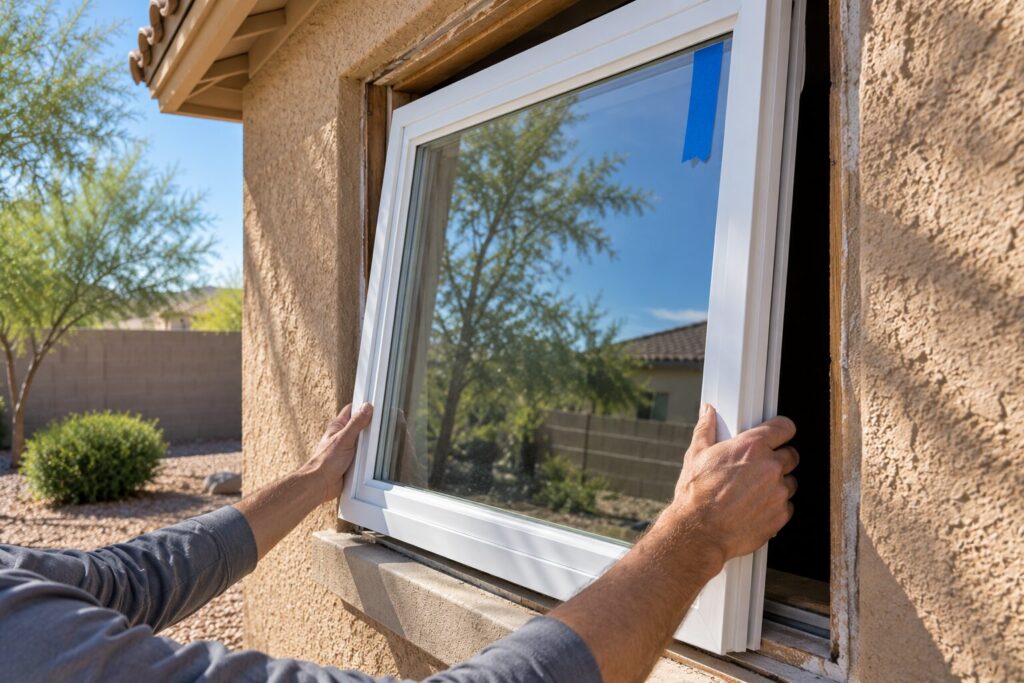
Most of the time, replacing a window in Phoenix means replacing the glass in it and leaving everything else where it is. The frame stays bolted in the wall, the stucco stays closed, and the sash goes back on its track carrying a new lite. Superior Replacement Windows has done this work across the metro since 2010, and it is the largest piece of our residential schedule.
Cracked, shattered, fogged between the panes, or wrong for the room, the fix is usually a piece of glass and part of an afternoon. Below is how we decide, what we can set into a frame you already own, and when the frame has to go.
What does window replacement mean when the frame is sound?
It means cutting the failed glass out, cleaning the glazing channel back to bare metal or vinyl, and bedding a new piece in the same opening with fresh setting blocks, sealant and bead. Nothing leaves the wall. No stucco gets cut, no drywall gets patched, no casing comes off, and no permit is pulled, because the envelope was never opened.
Homeowners call this a replacement window, a new window, or a reglaze, and all three describe the same job. If you want the difference between a sash, a lite, a bead and a stop before a technician uses those words at your house, our window glass terminology guide lays it out.
The frame outlives the glass sealed inside it
A window is three parts: a frame anchored to the wall, a sash that carries glass and slides or swings, and the glass. In this climate the third part fails first by a wide margin. Anodized aluminum frames from the 1970s are still square forty years on, and vinyl frames on tract homes built after 1995 sit tucked under stucco that shades the extrusion. Neither rots, because we get around eight inches of rain a year and there is no wood in the assembly to give up.
What fails is the glass and everything soft attached to it. Heat is the reason. A west-facing lite can run well past 150 degrees on its outer surface in July, and what surrenders under that daily cycling is the glazing tape, the perimeter sealant or the edge seal on an insulated unit. Ten or twenty summers will take out a seal. It will not warp a properly anchored aluminum extrusion.
When is a full window replacement the right call?
Sometimes it is, and we would rather say so on the first visit than sell you glass that will never seat. A frame that has lost its geometry cannot hold a lite square. These are the cases where we tell a homeowner the unit itself has to go:
- The frame is racked or bowed, usually from impact or a header that has settled onto it, so the sash binds and the corners no longer meet at ninety degrees.
- Aluminum has corroded through at the bottom corners. Sprinkler overspray and pool chemistry do this along south and west walls, and a pitted channel holds no bead.
- A wood sill has rotted under the glazing, which we find on older custom homes with wood or clad frames, almost never on aluminum tract windows.
- The sash is bent, or its corner keys have pulled apart, so rectangular glass would be asked to sit in a parallelogram.
- The opening has moved with the slab and sits out of square by enough that new glass binds hard on one side.
That list is short on purpose. It covers a small share of the windows we see. If yours belongs on it we will say which line it falls under and point you toward full window installation rather than take a deposit for glass that would not last. If it does not, and most do not, new glass in your frame is the honest answer.
What glass can we set into your existing frame?
Single pane comes first, because much of the housing stock here was glazed with it and most exterior doors still carry it. Three treatments, and where the glass sits decides which you get:
- Annealed. Ordinary float glass, cut on site from stock we carry, for fixed lites and openings nowhere near a door or a walking path.
- Tempered. Heat treated to roughly four times the strength of annealed, breaking into blunt pebbles instead of blades. Code calls for it in doors, sidelights, low sills and near a tub or shower.
- Laminated. Two lites bonded to a clear plastic interlayer. It meets the same safety glazing requirement as tempered, holds together when it breaks, and unlike tempered it can be cut.
Thickness follows the size of the opening, not preference. Small lites take single strength annealed at about 3/32 of an inch, and double strength at 1/8 covers most bedroom and kitchen windows. Past nine or ten square feet we step up to 3/16 or 1/4, because a thin sheet that wide flexes in a monsoon gust. Our page on single pane glass replacement works through those choices.
How is an insulated unit different from one piece of glass?
An insulated glass unit is two lites for dual pane, or three for triple, held apart by a spacer bar and sealed at the perimeter with dry air or argon inside. It drops into the sash as one piece. You cannot open it, refill it or re-seal it in the field, which is why a failed unit gets replaced rather than repaired.
Every one of ours is made to order. We measure your sash, hand the sizes to glass fabricators here in Phoenix, and the finished units come back in five to seven days. None of it comes off a shelf, and none is built in our own building. You pick the makeup: dual or triple pane, and what goes on the surface facing the sun. Dual pane glass replacement covers spacer types and unit construction.
Which coating or tint suits a west-facing wall?
Low emissivity glass, in nearly every case. Low-E is a microscopically thin metal oxide coating that passes visible light while turning back much of the infrared and ultraviolet. With more than 300 sunny days a year, ultraviolet is what bleaches flooring, leather and the spines of books near the window. Low-E is the standard pick here and reads close to clear. Nearly everything written about efficient glazing assumes a cold climate and a heating bill, which gets the priorities backwards for Arizona, so we set out what matters here in a guide to energy efficient windows for Arizona homeowners.
Tint is a different tool. Bronze and gray absorb light in the body of the glass, so they change how the room feels and how the house reads from the street. Homeowners pick them for glare on a patio wall or to match tinted glass already in the elevation, and low-E on a bronze lite is a normal order. What we would talk you out of is a dark tint chosen to fix heat gain, since glass that absorbs heat re-radiates much of it inward.
Obscure and patterned glass for bathrooms
Bathroom, stairwell and side-entry windows want daylight without a view in, and obscure glass gets there with texture rather than color. Rain, glue chip, satin and reeded each blur differently: satin reads as a soft even white, reeded throws vertical lines that distort far more. Two things matter. Anything within 60 inches of a tub or shower floor has to be safety glazing, so your obscure lite will be tempered and made to measurement. And these patterns have a face and a back, with the textured side turned inward where it stays clean.
Can new glass cut the noise from the road?
It takes the edge off a steady drone. Two levers do the work: mass and damping. A thicker lite resists being pushed by a sound wave, so a 1/4 inch piece where 1/8 used to sit is a real gain against low-frequency traffic noise. Laminated adds damping, because the interlayer absorbs vibration rather than passing it along.
The best move in a sash deep enough to take it is asymmetry: two lites of different thickness in one insulated unit, say 1/8 outside against 1/4 inside, because mismatched lites do not resonate at the same frequency. Keep expectations grounded. It helps against an arterial road or a flight path and does nothing about a leaf blower ten feet away. Air leaking past a worn sash cancels most of the gain, so a window that no longer closes tight is worth fixing first, which our residential window repair page covers.
Which window styles do we reglaze?
Horizontal sliders are the style we see most in the Phoenix area and the friendliest to work on, since the operating sash lifts out and gets reglazed on a bench in your driveway. Single hung windows come next, common on two-story tract homes, and their sash comes free the same way once the balances are unhooked. If your single hung sash drops the moment you let go, that is a balance problem and not a glass problem, and window balance replacement is the repair you want.
Picture windows and other fixed lites have no moving parts, so the job happens at the opening from a ladder or a lift. Casements swing out on a crank arm and carry a smaller lite that leaves with the sash. French doors and exterior door lites are their own category, because glass in a door is safety glazing without exception. We reglaze patio door panels too. Where a panel drags rather than breaks, start with sliding glass door repair, since a heavy door is usually talking about its rollers and track.
Why can’t tempered glass be cut on site?
Tempering locks the surface of the glass into compression and the core into tension. That stored balance is what makes it four times stronger and what makes it fail into harmless pebbles. Score, drill or notch it afterward and you release the whole system at once: the sheet does not part along your line, it lets go into gravel on the bench. Every tempered piece is fabricated to a measurement taken in advance, holes and cutouts included, which is why tempered work needs a measure visit first.
Laminated is how we beat that wait when a door is standing open to the street. It meets the same safety glazing requirement, it cuts cleanly, and we carry it in clear and bronze. A broken sidelight or door lite that would otherwise wait on a tempered order can often be cut, fitted and finished the same day. We do not substitute it everywhere: a shower enclosure is tempered, and where a door manufacturer specifies tempered, tempered goes back in.
Is a fogged unit a replacement job?
Yes. Once the edge seal lets go, humid air works its way in, the desiccant in the spacer saturates, and moisture condenses on surfaces no cloth will ever reach. No drilling, venting or drying trick hands you back a window that stays clear. The unit gets remade to your sizes and swapped in while the frame and sash stay put. Foggy window repair explains why seals fail early here and what the pattern of haze says about how far gone a unit is.
How a glass replacement runs, start to finish
Call (602) 777-3717 and describe the window: which room, roughly how wide and tall, single or dual pane, broken or clouded. That books a technician to the house. He measures the opening, checks the frame, confirms whether code calls for safety glazing there, and writes a quote. Nothing is owed until that written quote is in your hands.
Approve it and we collect a 50% deposit before glass is ordered. Your glass gets cut to your opening, and a piece cut for one house fits no other one. Hardware and stock sliding door glass are the exceptions, since those return to inventory. Custom insulated units come back from the fabricator in five to seven days and we set an install date from there. Our workmanship carries a lifetime limited warranty for as long as you own the property.
What decides the cost of a glass replacement?
Four things move the number. Glass type leads: annealed, tempered, laminated, insulated and coated all sit at different levels. Opening size is second, because square footage drives material and the thickness that size demands. Third is whether safety glazing is required there, which takes the choice out of everyone’s hands. Fourth is hardware and access, since a second-story lite over a rock yard is not the same work as a bedroom window at ground level.
We publish no figures here, because a number quoted without your measurements is a guess. The measure and the written quote cost nothing, and the quote pins the scope down before glass is cut.
Where do we work, and when?
We run out of 4202 E Elwood St #21, Phoenix, AZ 85040, and cover a 50 mile radius from it: Scottsdale, Mesa, Glendale, Chandler, Gilbert, Tempe, Peoria, Surprise and everything between. Elwood is a working shop, not a showroom, so the measuring happens at your house. Office hours are Monday to Friday, 7:30am to 5:00pm.
Common questions about window glass replacement
Who comes out to measure the window?
A working glazier, not a salesperson on commission. He measures the opening, inspects the frame and sash, and tells you on the spot whether glass alone solves it. If your frame is finished, he says so.
Where does the building code require safety glass in a home?
Glass in and beside doors, panes close to the floor or in a large low opening, glazing near tubs, showers and pools, and glass alongside stairs and landings. The triggers turn on distance from a door edge, height above the walking surface and the area of the pane. Our technician checks your location against those rules at the measure.
Do I need a permit to replace the glass in a window?
No. The frame stays anchored, the wall stays closed and the opening does not change size, so there is nothing for an inspector to review. Permits enter the picture when an opening is cut, widened or filled in.
Can you match the tint on the rest of my windows?
Usually. Bronze and gray are the tints we see most on Phoenix elevations, and both come in single pane and in insulated units. Matching an older tint is easier when we hold a sample against your glass in daylight, which the technician does at the measure.
How long does the installation itself take once the glass is here?
A standard slider or single hung sash is back in service inside an hour. A large fixed lite takes longer, since it needs two people, suction cups and sometimes a lift, and the old bead has to come off without marking the frame.
Will you take the broken glass away?
Yes. The old lite, the shards, the failed sealant and the packaging leave with the truck. We vacuum the track and sill before we go, since fragments left in a slider channel chew the weatherstrip and end up underfoot.
Can you replace just one pane of a dual pane window?
Not separately. The two lites, the spacer and the seal are made as one sealed assembly. The whole unit gets remade to your measurements, even when only the outer lite is broken.
To get a window measured and quoted, call (602) 777-3717 on a weekday and tell us what broke. You can also read the rest of our residential glass services, or start with home window repair if you are not sure whether the glass or the hardware is at fault.
We work across the Valley, inside 50 miles of the shop on Elwood Street. Start with your city for what we see most in the housing stock there.
The same safety glazing rule applies around a tub or shower, which is its own job: see frameless shower enclosures.